
Subdomains for Landing Pages: Why I Use Them for My Business and My Clients
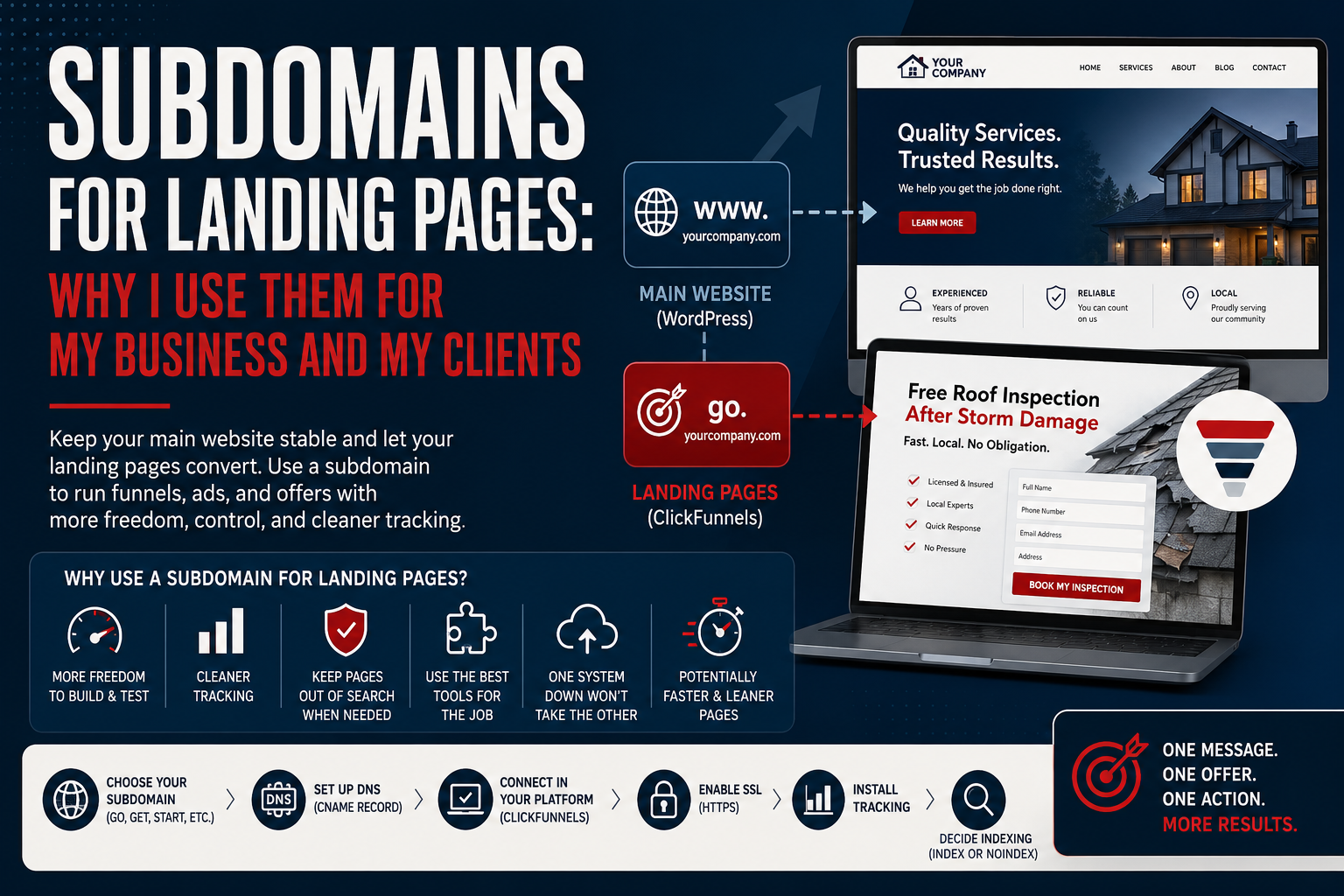
If you’re running ads, building lead-generation funnels, testing new offers, or creating landing pages for specific campaigns, there’s a super simple website setup I use for both my own business and my clients: put the landing pages on a subdomain.
Instead of putting everything directly on your main website, you might have www.yourcompany.com as your primary website and go.yourcompany.com for your funnels and landing pages. You could also use something like get.yourcompany.com, offers.yourcompany.com, start.yourcompany.com, or book.yourcompany.com.
The whole idea is simple. Your main website and your landing pages usually have two different jobs, so I don’t necessarily want them handcuffed to the exact same technology, design structure, development process, or even marketing strategy.
I do this with my own marketing. I do it with client campaigns. And if you’re regularly building landing pages, especially for paid traffic, it’s something I recommend considering.
It’s not because subdomains have some magical marketing superpower. They don’t. It’s because they give you separation without sacrificing your brand, and that can be super valuable.
Quick Answer: Why Use a Subdomain for Landing Pages?
A landing page subdomain lets you run campaign-specific pages separately from your primary website while still using your branded domain. For example, instead of sending an ad to randomcompany.clickfunnels.com/special-offer, you could send people to go.yourcompany.com/special-offer.
I primarily recommend this for paid advertising campaigns, lead-generation funnels, webinars, downloadable resources, appointment funnels, promotional offers, and other pages designed around one specific conversion action.
The biggest benefits include:
- More freedom to build conversion-focused pages
- Easier A/B testing and experimentation
- Cleaner campaign tracking
- Faster changes without constantly involving your website developer
- The ability to use specialized landing-page software
- Separation between your primary website and campaign infrastructure
- More control over whether experimental pages appear in search engines
- A consistent branded domain for visitors
For me, the real benefit is control. Your website gets to be a website. Your funnel gets to be a funnel.
Perfect.
What Is a Subdomain?
A subdomain is simply an extension that appears before your main domain name. Let’s say your website is example.com. You could create go.example.com.
In that example, example.com is your root domain, go is the subdomain, and go.example.com can point somewhere completely different from your main website.
So let’s say your main website runs on WordPress, but you want to build your landing pages using ClickFunnels. No problem. Your main site can continue living at www.example.com, while ClickFunnels handles go.example.com.
To the person visiting the site, it all still feels like the same company. Behind the scenes, they’re two different systems.
That’s the important part.
Why I Use Subdomains for Landing Pages
There are a bunch of reasons I like this setup, but most of them come back to one thing: landing pages need freedom to experiment.
Your main website usually needs stability. Your landing pages usually need the exact opposite.
Let’s break that down.
1. Your Landing Page Doesn’t Have to Follow Your Website’s Rules
I see this constantly. A company has a decent website. Maybe it’s WordPress. Maybe it’s Webflow. Maybe it’s something custom.
Then someone says, “We’re running a Facebook Ad. We need a landing page.”
Okay. Now the landing page needs to go through whoever manages the website. Somebody has to build a template, someone needs access, the page needs development, marketing notices the navigation is distracting, someone else says the navigation can’t be removed because it’s global, and then marketing wants to test another headline.
Something that should have taken an afternoon turns into a project.
You know what I mean?
That’s why I like separating the two. If I’m running landing pages through something like ClickFunnels, I can make the landing page do exactly what that campaign needs without redesigning the company’s entire website.
The website stays stable. The funnel keeps moving.
2. You Can Match the Landing Page Directly to the Ad
This is probably one of the biggest advantages. Let’s say you’re a roofing company.
Your main homepage might talk about roofing, siding, windows, gutters, financing, service areas, reviews, the company, and the team. That’s perfectly reasonable for a website.
But let’s say I run an ad that says:
Storm damage in Nashville? Get a free roof inspection.
Someone clicks that advertisement. What should they see?
Ideally, a page about getting a roof inspection after storm damage. Not a giant homepage asking them to choose between roofing, windows, siding, your company history, your blog, and seven other things.
They’re thinking, “I clicked this because I have storm damage. Can you help me or not?”
So answer that question.
That’s message match. The ad makes a promise, and the landing page immediately continues that exact conversation.
Your main website has to serve a bunch of different visitors. A landing page doesn’t. One audience. One problem. One offer. One action.
That’s the whole point.
3. Landing Pages Are Supposed to Change
This is also why I’m a little hesitant to make a company’s main website responsible for every advertising experiment we run. A landing page isn’t supposed to be perfect. It’s supposed to get better.
Maybe I test two headlines, a shorter form versus a longer form, different calls to action, a video versus no video, different testimonials, different guarantees, different pricing language, different offers, or different page structures.
Maybe Version A converts at 3% and Version B converts at 5%.
Guess what? Version B wins.
Done.
Then we test something else. That’s marketing.
If every little experiment requires editing the company’s primary website, we’re adding unnecessary friction to something that should move quickly. This is one of the reasons I’ve gravitated toward dedicated funnel software.
I want the ability to say, “I wonder if this works better,” and then test it. Not schedule a development meeting for next Thursday.
4. Tracking Can Be Much Cleaner
Using a dedicated landing-page environment can also make campaign measurement easier. Notice I said can. A subdomain doesn’t magically improve your analytics just because it exists. You still have to set everything up correctly.
But organizationally, I find it super helpful. If most of my paid campaigns live under something like go.example.com, I have a very obvious way to separate campaign traffic from regular website behavior.
I can track landing-page visitors, form submissions, booked calls, purchases, cost per lead, cost per booked appointment, cost per customer, conversion rates, traffic sources, and campaign performance. Depending on the analytics platform, you can use the same analytics property and segment traffic by hostname or create additional reporting structures where it makes sense.
The important part isn’t the subdomain. The important part is knowing whether the campaign actually worked.
That’s something I preach constantly. If you spend $2,000 on advertising and generate 50 leads, that’s interesting. If you spend $2,000 and generate $20,000 in customers, that’s useful.
I care about the second number.
5. You Can Keep Paid Landing Pages Out of Search When Appropriate
This is an area where I want to clear up a common misconception.
You’ll sometimes hear people say you need a subdomain because paid landing pages have high bounce rates, short sessions, or change frequently, and Google will punish your primary website because of it. I wouldn’t explain it that way.
Google does not simply look at a paid landing page, see someone leave quickly, and slap your entire website with an SEO penalty. Changing a headline because you’re running an A/B test doesn’t somehow get you in trouble with Google either.
The better reason is control.
If I’m creating highly experimental landing pages specifically for paid advertising, I may not want those pages appearing in organic search results at all. In that case, I can deliberately tell search engines not to index them.
That lets me build the page entirely around the person coming from the advertisement without worrying about whether the page also needs to function as an organic search page. Those are two different jobs.
For pages that are designed to attract organic search traffic, I take a very different approach and build around SEO, search intent, internal linking, topical relevance, and the other signals needed to perform organically.
It’s not, “Subdomains are good for SEO.”
It’s: Use the right page structure for the job you’re asking that page to do.
Big difference.
6. Your Main Website and Landing Pages Can Use Different Technology
This is one of my favorite reasons. You might love your main website. Keep it.
You don’t need to rebuild your entire website because you want ClickFunnels.
This is where the subdomain becomes super useful. You can have www.yourbusiness.com running on WordPress while go.yourbusiness.com runs through ClickFunnels.
The customer doesn’t need to understand what’s happening behind the scenes. It all belongs to your brand.
Think of it like having two departments in the same building. The front office does one thing. The sales department does something else. They don’t need to sit at the same desk to work for the same company.
7. It Can Reduce Website Compatibility Problems
WordPress is incredibly powerful. I use it.
But anybody who has spent enough time working with WordPress also knows the game: theme, plugins, another plugin, another plugin, update, something breaks.
Why?
Who knows.
Rabbit hole.
Now imagine adding a bunch of campaign pages, tracking scripts, forms, dynamic elements, checkout functionality, A/B testing software, and whatever else you’re experimenting with directly into that environment.
Sometimes that’s fine. Sometimes you’re creating more moving parts than you need.
If my funnel can live separately, I can keep that complexity out of the main website.
Least amount of work. Biggest possible win.
That’s usually what I’m looking for.
8. One System Can Go Down Without Necessarily Taking Down the Other
This is another benefit people don’t think about until something breaks.
Let’s say your WordPress website gets knocked offline because of a plugin conflict, bad update, server issue, theme problem, or development mistake. If your advertising landing pages are hosted separately through ClickFunnels on a subdomain, a WordPress-specific outage doesn’t necessarily take those landing pages down with it.
That’s a big deal if you’re actively spending money on advertising.
Imagine spending $500 a day sending traffic to a dead page.
Not fun.
Separate infrastructure creates some redundancy. It doesn’t make you invincible, because a DNS problem can still cause trouble, but one broken WordPress plugin doesn’t have to shut down your entire advertising machine.
9. You Can Potentially Make Landing Pages Faster
Notice the word potentially.
Subdomains are not inherently faster. go.example.com isn’t faster than example.com just because there’s a word in front of it.
The advantage is that a dedicated landing-page platform allows you to build a much leaner page. Your homepage might load navigation, blog components, multiple plugins, site-wide scripts, popups, chat software, complex styling, huge image libraries, and third-party integrations.
Your advertising page might need a headline, some copy, a few images, testimonials, a form, and a button.
That’s it.
Less junk can mean faster loading, and speed matters when you’re paying for every click.
10. Your Marketing Team Can Make Decisions Faster
This one gets more important as the company gets larger.
Let’s say you have a developer, marketing manager, sales leader, operations person, and maybe an outside agency involved. If marketing wants to test a new landing-page headline, does everyone really need to be part of that decision?
Probably not.
But when the landing page lives inside the primary website, that’s sometimes what happens. The website is treated like sacred ground. Everything needs approval.
A dedicated landing-page environment changes the psychology.
This is the laboratory. We test things here.
If something works, great. If it doesn’t, we change it.
That’s how you get better campaigns.
Should You Use a Subdomain or a Subdirectory?
This is where context matters.
A subdomain looks like go.example.com. A subdirectory looks like example.com/go/.
Neither is universally “better.” I normally think about the job of the page.
If the page is primarily designed for paid traffic:
I usually like the subdomain approach. It gives me more freedom to use dedicated software, experiment aggressively, separate the infrastructure, and control indexing.
If the page is primarily designed to rank organically:
I am much more likely to consider putting it inside the primary website architecture, particularly when it belongs within an existing topic cluster.
For example, example.com/roofing/commercial-roofing/ is supposed to participate in the site’s larger SEO strategy.
That’s different from go.example.com/free-roof-inspection, where I may simply want someone from a paid advertisement to book an appointment.
Again, it’s not subdomain versus subdirectory. It’s: What is this page supposed to accomplish?
Once you answer that, the technology decision gets a lot easier.
Why I Use ClickFunnels for Landing Pages
There are a bunch of landing-page builders available. I’ve used and worked around plenty of different marketing platforms over the years, but for dedicated funnels and landing pages, I personally use and recommend ClickFunnels.
Part of the reason is right there in the name. It isn’t trying to be your WordPress replacement. It’s built around funnels.
That means I can build the journey around what happens next. Someone sees an advertisement, they click, they land on a page, they submit a form, maybe they see another offer, maybe they book a call, maybe they receive an email sequence, or maybe they’re brought into another part of the customer journey.
That’s a funnel.
Russell Brunson has been teaching this concept for years, and one of the simplest explanations is that you don’t just want a collection of webpages. You want to intentionally move somebody from where they are to whatever the next logical step should be.
That’s a big distinction.
Want to Try ClickFunnels?
If you’re interested in testing it, I have an affiliate link that gives you three months of ClickFunnels for $99:
Get 3 Months of ClickFunnels for $99
Affiliate disclosure: That is an affiliate link. If you sign up through it, I may receive a commission at no additional cost to you.
If you’re going to experiment with landing pages, funnels, lead magnets, paid advertising, or online offers, it’s a pretty inexpensive way to get your hands dirty and actually build something.
Which is usually how I recommend learning this stuff anyway. Don’t just read about funnels.
Build one.
Want to Understand Funnels Better? Read DotCom Secrets
If ClickFunnels is the software, Russell Brunson’s book DotCom Secrets is one of the better places to understand the strategy behind what you’re building.
You can get a copy of DotCom Secrets for free and just cover shipping. That is also an affiliate link.
I’ve always liked Brunson’s work because he doesn’t just talk about building individual pages. He teaches you to think through the larger customer journey: where someone comes from, what they see, what you offer them next, and how those individual pieces connect.
That’s the difference between randomly building landing pages and actually building a marketing system.
How to Set Up a Subdomain for a Landing Page
The exact buttons will depend on who manages your domain and which landing-page platform you use, but the process generally looks like this.
Step 1: Choose Your Subdomain
Let’s say you own example.com. Choose something like go.example.com.
I tend to like short subdomains because they’re easy to remember and don’t look ridiculous inside an advertisement. Some good options include:
gogettrystartjoinbooklearnoffersinfodiscover
You can also use something campaign-specific, such as challenge.example.com or event.example.com.
My only recommendation is that you don’t try too hard. If you find yourself creating best-award-winning-exclusive-offer.example.com, we’ve gone too far.
Keep it simple.
Step 2: Go to Your Domain’s DNS Settings
DNS basically tells the internet where different parts of your domain should go.
Think of it like the directory at the entrance to an office building. Main website? Third floor. Email? Fifth floor. Landing pages? Second floor.
When someone asks for go.example.com, the DNS record tells their browser where to send them.
Step 3: Create the Record Required by Your Landing-Page Platform
Most landing-page platforms will give you specific instructions for connecting the subdomain. This commonly involves creating a CNAME record, which is basically a DNS record telling your subdomain to point toward another service.
If you’re using ClickFunnels, follow the domain instructions inside your ClickFunnels account because the exact configuration can change over time.
Don’t guess.
Your registrar and ClickFunnels will tell you exactly what values belong in each field.
Step 4: Add the Subdomain to Your Landing-Page Platform
Once your DNS record is created, add the complete subdomain inside ClickFunnels or whichever landing-page builder you’re using, such as go.example.com.
The platform then checks whether the DNS is pointing correctly. DNS changes aren’t always instant, so don’t freak out if it doesn’t verify three seconds later.
Step 5: Make Sure SSL Is Active
You want the page loading securely over HTTPS.
So instead of http://go.example.com, you want https://go.example.com.
Most major landing-page services make this fairly straightforward once the domain is connected.
Step 6: Install Your Tracking
This is where people build a beautiful funnel and then completely screw up the part that tells them whether it works.
Install whatever measurement tools your campaign requires. That may include:
- Google Analytics
- Google Tag Manager
- Google Ads conversion tracking
- Meta Pixel
- CRM tracking
- Call tracking
- Form conversion events
- Purchase events
- Appointment-booking events
The whole idea is to connect the advertising dollars to the actual result.
Clicks are nice. Customers are better.
Step 7: Decide Whether the Page Should Be Indexed
This is important.
Don’t automatically noindex every landing page. Ask: Do I actually want someone finding this page through Google?
If the answer is no because this is a temporary paid campaign, experimental offer, thank-you page, or other funnel step, preventing indexing may make sense.
If the page is intentionally designed to attract search traffic, that’s a completely different situation. Then you need to think about SEO, content quality, search intent, internal links, page structure, and whether this page belongs within your primary website.
Rule. Reason. Exception.
That’s how I like to think about it.
What Should You Name Your Landing Page Subdomain?
This matters less than people think, but there are a few good approaches.
Use an Action Word
These work well because they naturally suggest the next step:
go.example.comstart.example.comtry.example.comjoin.example.combook.example.com
Simple.
Use the Type of Offer
If you run a specific type of campaign repeatedly, you could use events.example.com, offers.example.com, learn.example.com, demo.example.com, or resources.example.com.
This can make the URL immediately understandable.
Use the Campaign Name
For larger campaigns, you can make the campaign itself the subdomain. For example, challenge.example.com, conference.example.com, or academy.example.com.
I wouldn’t do this for every tiny campaign because you’re just creating more stuff to manage.
Again: least work. Biggest win.
Don’t Fake Urgency or Credibility
I wouldn’t recommend creating something like awardwinning.example.com unless you actually have a relevant award. Same with exclusive.example.com or limited.example.com.
If the offer isn’t actually exclusive or limited, don’t pretend it is.
Marketing works better when you don’t have to lie to make it persuasive.
Don’t Treat a Subdomain Like Security
One more clarification: putting landing pages on a subdomain does not make them secret.
Could it keep them separated from the normal navigation and obvious page structure of your main website? Sure. But if a competitor is determined to find your advertising campaigns, a subdomain is not Fort Knox.
If something truly needs to be private, protect it properly. Don’t rely on obscurity.
The value of the subdomain is organization and flexibility, not cybersecurity.
The Bigger Idea: Stop Making One Website Do Everything
This is really the lesson.
Business owners have a tendency to think, “I have a website. Therefore, everything online has to happen inside that website.”
Not true.
Your website is one part of your marketing system. Your funnels are another. Your CRM is another. Your email system is another. Your advertising platforms are another. Your analytics are another.
The goal isn’t to force every tool into one box. The goal is to make all of the pieces work together.
That’s how I approach my own marketing, and it’s how I approach client work.
If WordPress is the best tool for the main website, great. If ClickFunnels is the best tool for the funnel, great.
Connect them.
Done.
I’d rather have five tools that are each excellent at their job and work together than force everything through one platform simply because someone told me it was “all-in-one.”
The customer doesn’t care.
They care whether the experience works.
So, Should You Use a Subdomain for Your Landing Pages?
If you’re regularly running paid traffic or building dedicated lead-generation funnels, yes, I strongly recommend considering it.
Especially if:
- Your primary website runs on WordPress or another CMS
- You want to use ClickFunnels or another dedicated funnel builder
- You’re regularly testing offers
- Marketing needs to move faster than your web development process
- You want campaign pages separated from your main site architecture
- You want more control over which pages search engines index
- You’re building multiple lead magnets or funnels
- You’re spending enough on advertising that website downtime costs real money
If you have three webpages, no advertising, and no plans to build funnels? Don’t overengineer this. You probably don’t need it yet.
Like most marketing tools, subdomains are useful when they solve an actual problem, not because somebody on YouTube said every company needs one.
Frequently Asked Questions About Subdomains for Landing Pages
What is a subdomain for a landing page?
A landing-page subdomain is an extension of your main domain that can point to a separate landing-page platform. For example, if your main website is example.com, you could host campaign landing pages at go.example.com.
This lets you keep the branding of your primary domain while using separate technology for your funnels.
Should I use a subdomain for landing pages?
I generally recommend considering a subdomain when the landing pages are primarily being used for paid advertising, lead generation, promotions, webinars, downloads, or other conversion-focused funnels.
If you’re creating pages primarily to rank in organic search results, I would evaluate whether they make more sense inside your primary website architecture instead.
Is a subdomain or subdirectory better for landing pages?
It depends on the page’s purpose.
For paid campaigns and highly experimental funnels, I generally prefer subdomains because they give you more technical and operational freedom. For pages designed primarily around SEO, a subdirectory within the primary site’s content architecture may make more sense.
Don’t start with the URL structure. Start with the job the page needs to perform.
Does using a subdomain hurt SEO?
Not automatically.
Using a subdomain doesn’t inherently hurt your main website’s SEO, nor does it magically improve it. Search engines can discover, crawl, and index subdomains like other web content.
That’s why I prefer to make indexing decisions intentionally. If a paid campaign page shouldn’t appear in organic search, I can prevent indexing. If I want a page attracting search traffic, I optimize it accordingly.
Do high bounce rates on landing pages hurt my main website’s SEO?
I would not build your strategy around that assumption.
Paid landing pages often create unusual behavior because the visitor is being asked to perform one specific action. Someone could land on a page, submit a form in 45 seconds, leave, and be a fantastic conversion.
That’s why context matters. Use your analytics to judge whether the landing page is accomplishing its business goal rather than obsessing over a single engagement metric.
Should paid landing pages be indexed by Google?
Often, no.
If the page exists solely for a paid campaign, temporary promotion, funnel step, or A/B test, there may be little reason for it to appear in organic search results.
But this isn’t an automatic rule. If you’ve built a high-quality landing page that intentionally targets organic search demand, indexing may absolutely make sense.
Ask what the page is supposed to do first.
Can my website be on WordPress while my landing pages are on ClickFunnels?
Yes. This is actually one of my favorite reasons to use subdomains.
Your main website can remain on WordPress at www.example.com, while a subdomain such as go.example.com points to ClickFunnels. You don’t have to rebuild your website just because you want a dedicated funnel platform.
Can I use a subdomain with ClickFunnels?
Yes. ClickFunnels supports connecting custom domains and subdomains so your funnels can use your company’s branded URL rather than a generic ClickFunnels URL.
This is the setup I recommend when you want to keep your main website where it already lives while letting ClickFunnels handle your dedicated funnels.
What is the best subdomain name for landing pages?
My default recommendation is something short and flexible. Good options include go, get, start, try, join, book, offers, or learn.
For example: go.example.com.
Don’t spend four hours trying to invent the world’s greatest subdomain. Nobody buys because your subdomain was brilliant.
Can I create more than one landing page on the same subdomain?
Absolutely. In fact, that’s usually what I recommend.
You could have go.example.com/free-guide, go.example.com/demo, go.example.com/webinar, and go.example.com/consultation.
You normally don’t need to create another subdomain for every campaign. Keep the infrastructure simple.
Do I need separate analytics for my landing-page subdomain?
Not necessarily.
You can often track both your main website and your subdomain within the same analytics environment and segment the data appropriately. There are situations where separate properties or reporting setups make sense, but don’t create complexity merely for the sake of complexity.
The goal is clean measurement.
Does putting landing pages on a subdomain hide them from competitors?
Not reliably.
A subdomain can keep campaign pages outside the obvious navigation and sitemap structure of your primary website, but it shouldn’t be treated as a security measure. If information truly needs to remain private, use actual access controls.
Can I use landing-page subdomains for Google Ads and Meta Ads?
Yes. That’s one of the primary ways I use this setup.
You can build campaign-specific pages around the audience, advertisement, offer, and call to action without forcing every campaign through the general-purpose structure of your main website.
That usually gives you much more room to test and improve the conversion path.
Want Help Building Your Landing Pages or Funnels?
If you’ve gotten this far and you’re thinking, “Okay, this makes sense, but I have no idea how I should actually set mine up,” that’s exactly the kind of thing I help businesses figure out.
You can book a one-hour paid marketing consultation with me here. We’ll look at what you’re currently doing, what you’re trying to accomplish, and what actually makes sense for your business.
You can also reach out through my contact page if you’d like to talk about a larger project.
If you prefer to build it yourself, these are the two resources I’d start with:
Want the software? Get three months of ClickFunnels for $99 through my affiliate link.
Want to understand the strategy first? Get Russell Brunson’s DotCom Secrets free and cover the shipping.
Both of those are affiliate links, so I may earn a commission if you purchase through them at no additional cost to you.
And if you want to dig deeper into attracting traffic organically, you can check out my articles on search engine optimization here.
So that’s the idea.
Your website doesn’t have to do everything. Let your website be your website. Let your landing pages sell the offer. Connect the systems behind the scenes.
Then track whether it actually works.
That’s marketing.