
Want More Luck in Business? Focus on Marketing.
Most business owners talk about luck like it is this magical thing that either happens to you or it doesn’t.
And to be fair, some of it is.
Sometimes the right person walks into your store.
Sometimes a random referral shows up.
Sometimes a competitor screws up at the exact moment you are ready to take market share.
Sometimes you meet someone at an event who changes the next five years of your life.
That stuff happens.
But here’s the problem: if your entire business growth strategy is “hopefully someone gets lucky and finds us,” that is not strategy.
That is wishing.
And the more I think about this, the more I think most business owners misunderstand luck. They treat luck as if it is completely random, when in reality, a lot of luck is created by motion, awareness, and uniqueness.
Which is basically another way of saying:
Luck is not just what happens to you.
Luck is what you create more surface area for.
The Four Types of Luck
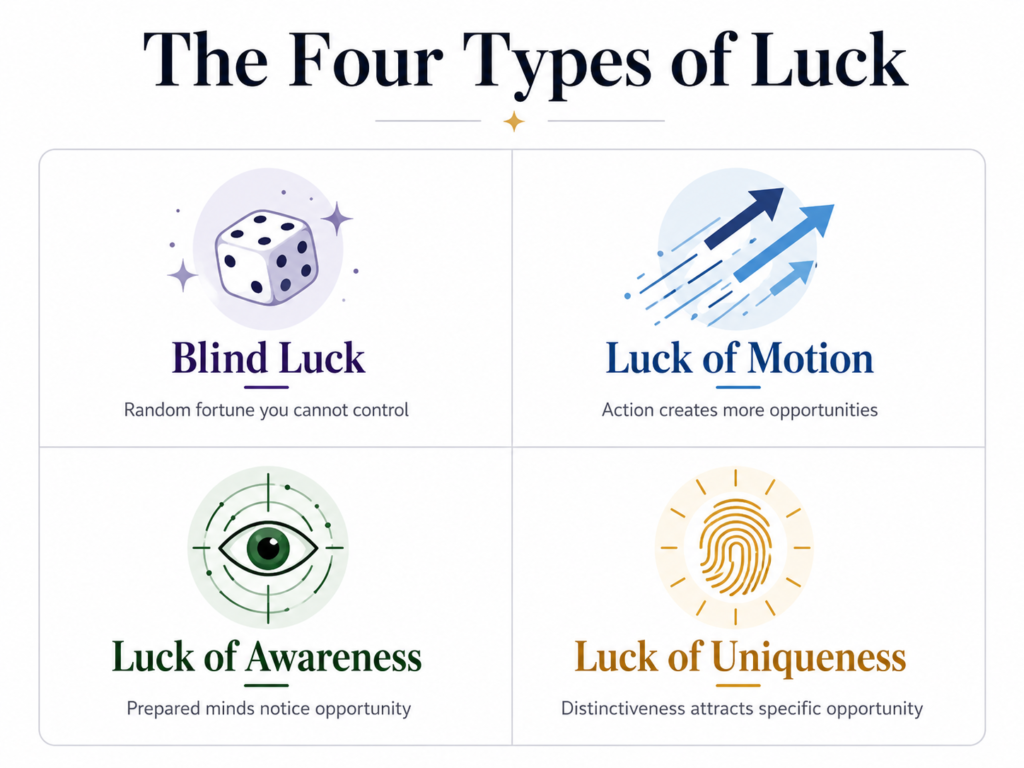
In 1978, neurologist Dr. James Austin wrote Chase, Chance, and Creativity, where he outlined four types of chance.
Now, he used the word “chance,” but in business conversations, I think “luck” and “chance” are close enough that we can use them almost interchangeably.
Because when a founder says, “We got lucky,” what they usually mean is, “Something happened that we did not fully control, but it helped us.”
That is luck.
Or chance.
Whatever word you want to use, the idea matters.
The simplified version looks like this:
| Type of Luck | Simple Explanation |
|---|---|
| Blind Luck | Random fortune you cannot control. |
| Luck of Motion | Action creates more lucky opportunities. |
| Luck of Awareness | Prepared minds notice hidden opportunities. |
| Luck of Uniqueness | Your distinctiveness attracts specific luck. |
That alone is fascinating.
Because most people talk about luck as if it is only the first one.
Blind luck.
The random stuff.
The “I was in the right place at the right time” stuff.
But three out of the four types of luck are not really random in the way most people think they are.
They are influenced.
Not controlled.
Not guaranteed.
Not perfectly predictable.
But influenced.
And in business, that distinction matters a lot.
Because if luck can be influenced, then luck can be designed for.
The Four Core Roles of a Business
Now, let’s connect that to business.
Responsibilities Over Personalities
In Chapter 14 of The E-Myth Revisited, Michael E. Gerber talks about organizational strategy. His point is that businesses should not be organized around personalities. They should be organized around functions, accountabilities, and responsibilities.
That sounds simple.
But it is one of those ideas that punches you in the face once you actually understand it.
Because most small businesses are organized around whoever happens to be standing nearby.
Who handles sales?
Well, whoever has time.
Who handles operations?
Whoever is least overwhelmed today.
Who handles finance?
Usually the owner, at 11:47 p.m., wondering why QuickBooks looks like a crime scene.
Gerber’s point is that if everyone is doing everything, no one is truly accountable for anything.
So in his organizational chart example, he breaks the company into major functional roles, including:
| Role | Core Function |
|---|---|
| President / COO | Accountable for the Strategic Objective. |
| VP Marketing | Finds customers and new ways to satisfy them. |
| VP Operations | Keeps customers by delivering what was promised. |
| VP Finance | Supports profitability and secures needed capital. |
The Four Core
For our purposes, I’d simplify that into the four core business functions:
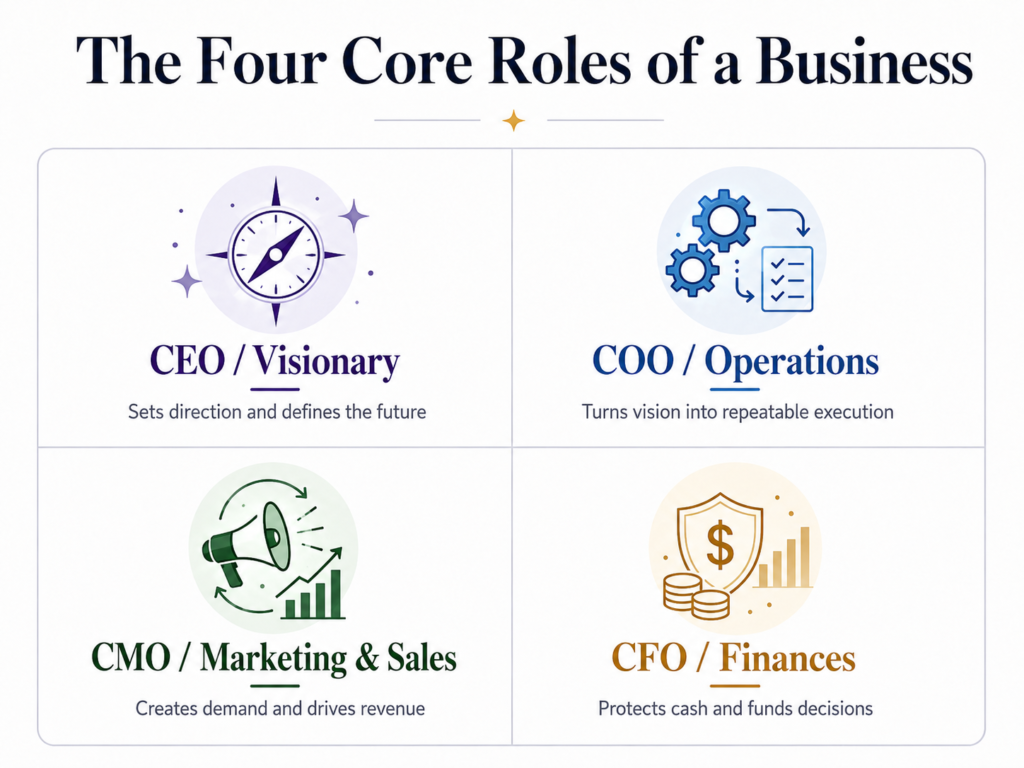
| Role | Core Function |
|---|---|
| CEO / Visionary | Sets direction and defines the future. |
| COO / Operations | Turns vision into repeatable execution. |
| CMO / Marketing & Sales | Creates demand and drives revenue. |
| CFO / Finance | Protects cash and funds decisions. |
Obviously, in a small business, one person might be wearing all four hats.
The owner might be the CEO, COO, CMO, CFO, salesperson, janitor, customer service rep, and part-time therapist.
I get it.
But even if the same person owns all four roles, the roles themselves are still different.
Vision is not operations.
Operations is not marketing.
Marketing is not finance.
Finance is not vision.
They all matter.
But when it comes to creating luck in business, they do not all create the same amount of leverage.
The Funny Thing Gerber Says About Luck
There is a line in The E-Myth Revisited that fits this idea almost too perfectly.
Gerber basically says that without an organizational chart, everything hinges on luck, good feelings, personalities, and goodwill.
And his point is: that is chaos.
That is not a business.
That is a mob with invoices.
And he is right.
If your business only works because the right person remembers to do the right thing at the right time, you do not have a system.
You have hope wearing a name tag.
But here is where I would take the idea one step further.
The goal is not to remove luck from business entirely.
You can’t.
Luck will always be there.
The goal is to stop depending on blind luck and start building systems that create the better kinds of luck.
Luck of motion.
Luck of awareness.
Luck of uniqueness.
And when you look at the main functions of a company, one role seems to have more leverage over those types of luck than any other.
Marketing.
Which Role Creates the Most Luck?
If we map the four types of luck against the four core business roles, the table starts to look something like this:
| Role / Luck Type | Blind Luck | Luck of Motion | Luck of Awareness | Luck of Uniqueness |
|---|---|---|---|---|
| CEO / Visionary | X | X | X | |
| COO / Operations | X | |||
| CMO / Marketing & Sales | X | X | X | |
| CFO / Finance | X |
This is not perfect science.
This is a thinking tool.
But I think it reveals something important.
The CEO and CMO both overlap with three types of luck.
The COO overlaps strongly with motion because operations turns repeated action into reliable execution.
The CFO overlaps with awareness because finance helps you notice risk, timing, runway, margins, leverage, and when an opportunity is actually affordable.
But marketing and sales?
Marketing and sales may be the biggest luck amplifier in the entire company.
Because the CEO can choose the direction.
The COO can build the machine.
The CFO can protect the downside.
But marketing and sales are usually where the business collides with the outside world.
And that is where luck happens.
Marketing Creates Luck of Motion
Luck of motion is the easiest one to understand.
If you do more things, more things can happen.
That sounds stupidly simple, but most businesses do not behave this way.
They want referrals, but they do not ask for them.
They want leads, but they do not publish content.
They want sales calls, but they do not follow up.
They want word-of-mouth, but they do not give people anything interesting to talk about.
They want opportunities, but they are barely visible.
It’s like saying you want to bump into someone at the gym, but you never go to the gym.
Marketing changes that.
Every ad, email, social post, sales call, landing page, event, webinar, podcast appearance, lead magnet, referral request, and follow-up sequence creates another chance for the market to respond.
That does not mean every action works.
Most of them won’t.
But motion creates collisions.
And collisions create opportunity.
For example, let’s say a local service business sends one email a year to its customer list.
That gives them one real chance to reactivate old customers.
Now let’s say they send two useful emails per month, post three times per week, run a small retargeting campaign, ask happy customers for reviews, and follow up with every old lead in their CRM.
Did they guarantee luck?
No.
But they created a lot more places where luck can show up.
That is marketing.
Marketing is not just “making things look nice.”
Marketing is controlled motion.
Marketing Creates Luck of Awareness
The second type of luck marketing creates is awareness.
This is where a business starts noticing things other people miss.
A customer says something on a sales call.
A competitor changes their offer.
A certain landing page starts converting better.
A random LinkedIn post gets more attention than expected.
A Google Search Console query shows people are finding you for a problem you did not realize they cared about.
That is luck of awareness.
But you only notice those things if you are close enough to the market to see them.
This is why marketing and sales should not be treated like some little department that “gets the word out” after the real business decisions are made.
Marketing is where the market talks back.
Sales calls tell you what people actually care about.
Ad comments tell you what people are confused by.
Search data tells you what people are already looking for.
Email replies tell you what objections are sitting in the back of your prospect’s mind.
Analytics tell you where people lose interest.
This is not just promotion.
This is intelligence.
A good marketing system does not just create leads.
It creates learning.
And in business, learning faster than your competitors is one of the closest things you can get to manufacturing luck.
Marketing Creates Luck of Uniqueness
The third type of luck marketing influences is uniqueness.
This is the weird one.
Luck of uniqueness is when your specific traits, positioning, experience, personality, network, or way of doing things attracts specific opportunities.
This is not “be different” in the generic branding sense.
This is not putting a neon gradient on your website and calling yourself disruptive.
This is about becoming clearly associated with something specific enough that the right opportunities know where to land.
For example, if you are “a marketing agency,” that is not very unique.
There are a million marketing agencies.
But if you are the agency that helps local home service companies dominate Google Maps in mid-sized markets, that is more specific.
If you are the fractional CMO who builds AI-assisted growth systems for service businesses doing $1M to $10M a year, that is more specific.
If you are the consultant who helps spiritual authors turn books, retreats, courses, and memberships into a full customer journey, that is more specific.
Specificity attracts luck.
Because people can remember you.
They can refer you.
They can categorize you.
They can say, “Oh, you need to talk to this person.”
That is not random.
That is positioning.
And positioning is marketing.
The CEO Defines the Game. Marketing Creates the Openings.
Now, I want to be careful here.
I am not saying marketing is more important than vision.
A bad CEO with good marketing can create a lot of noise in the wrong direction.
That happens all the time.
The CEO chooses the game.
The CEO decides where the company is going, what the company believes, what market it serves, what tradeoffs it is willing to make, and what future it is trying to create.
That matters.
But once the direction is chosen, marketing creates the surface area for luck.
The CEO is the compass.
Marketing is the radar, the signal flare, and the outreach team all at once.
The COO turns the lucky break into a repeatable process.
The CFO makes sure the lucky break does not bankrupt the company.
But marketing is usually where the break happens first.
A founder meets an investor because of a podcast interview.
A consultant lands a client because of a LinkedIn post.
A local company gets a massive opportunity because their Google Business Profile showed up at the right moment.
A startup gets noticed because their positioning finally made the problem obvious.
A service business gets referrals because they kept educating their audience long after everyone else got quiet.
That is business luck.
And most of it started with marketing.
Most Businesses Are Not Unlucky. They Are Under-Marketed.
This is the part that business owners may not want to hear.
A lot of businesses are not unlucky.
They are under-marketed.
They are under-positioned.
They are under-followed-up-with.
They are under-distributed.
They are under-visible.
They are sitting on good products, good services, good teams, and good intentions, but the market barely knows they exist.
Then they look at the competitor who seems to get all the opportunities and say, “They got lucky.”
Maybe.
But maybe they also posted more.
Maybe they followed up more.
Maybe they made more offers.
Maybe they went to more events.
Maybe they asked more customers for reviews.
Maybe they tested more hooks.
Maybe they built more partnerships.
Maybe they made themselves easier to find, easier to remember, and easier to refer.
That is not blind luck.
That is luck of motion, awareness, and uniqueness working together.
If You Want More Luck, Build a Marketing System
The answer is not to “do more marketing” in the vague sense.
That is too broad.
That is like saying “get healthier.”
Okay. How?
The better answer is to build a marketing system that increases your odds of useful collisions.
That system should do a few things:
- Create consistent motion.
- Capture market feedback.
- Make your uniqueness obvious.
- Follow up with people who show interest.
- Turn learning into better offers, messaging, and sales.
For example, a simple version might look like this:
You publish useful content every week.
You drive traffic to one clear offer.
You capture leads with a helpful resource.
You follow up automatically through email and SMS.
You retarget people who visited important pages.
You ask customers why they bought.
You ask lost prospects why they did not.
You use that information to improve the offer.
Then you repeat.
That is not complicated.
But it is powerful because it compounds.
Every loop creates more motion.
Every conversation creates more awareness.
Every refinement sharpens uniqueness.
And over time, the business starts looking “luckier.”
But it is not magic.
It is a system.
The Real Point
Business will always involve luck.
Anyone who says otherwise is probably selling you something.
Timing matters.
Relationships matter.
Market conditions matter.
Random events matter.
But the mistake is thinking that because luck exists, you have no influence over it.
You do.
Not over all of it.
But over a lot more than most people think.
You cannot control blind luck.
But you can create motion.
You can build awareness.
You can sharpen uniqueness.
And of all the functions in a company, marketing and sales have the most direct leverage over those three things.
So if you want more luck in business, do not just wait for it.
Market.
Make more offers.
Have more conversations.
Publish more useful ideas.
Follow up more consistently.
Study what the market is telling you.
Make your company easier to find, easier to understand, easier to remember, and easier to refer.
Because luck may not be fully controllable.
But it is absolutely influenceable.
And marketing is how you influence it.